Leicester Abbey
Wolf HallLeicester Abbey is the final stop in Thomas Wolsey’s forced journey from arrest to death. There, separated from Thomas Cromwell, the fallen cardinal dies after a prolonged illness and is buried in a plain coffin; the modest funeral becomes a stark measure of the distance between the power he once held and the end prepared for him.
Wolsey’s final journey
After his arrest at Cawood on 1 November 1530, Wolsey was taken under guard first to Pontefract Castle, then to Doncaster, and onward to Sheffield Park, the Earl of Shrewsbury’s home. He fell ill there. On 26 November, the Constable of the Tower arrived with twenty-four men-at-arms to escort him south. Wolsey was taken to Leicester Abbey, where he died three days later.
The arrest had interrupted a carefully anticipated arrival in York: Wolsey had been due to reach the city for his investiture, and his bags were already packed. In George Cavendish’s account, the journey to Leicester follows a rapid collapse in the cardinal’s health. Wolsey had gone without food for a week, complained of a cold, hard feeling in his chest, and later became too weak to stand. The narrative presents the illness and arrest as overlapping pressures, without establishing that his death was deliberately caused.
The last hours
Cavendish recounts that, at Leicester, Wolsey woke during the night and asked whose shadow was moving on the wall. He called for Cromwell, who was not there. Cavendish had told him that Cromwell was on the road, trying to reassure him that his friend would come.
The following morning, Wolsey refused chicken broth because he believed it was a meatless day. He had been ill for eight days, and Cavendish describes him as in pain and continually unwell. Wolsey died at eight the next morning, with his attendants gathered around him. The account gives the scene through Cavendish’s recollection, making his testimony both the record of Wolsey’s final hours and an expression of the distress of the man who witnessed them.
Burial and its contrast
Cavendish washed Wolsey and prepared him for burial. Beneath his shirt he found a hair shirt, which he believed Wolsey had begun wearing while among the monks at Richmond. The monks at Leicester kept it. The detail complicates the image of the former prince of the Church: alongside the splendour and authority associated with his public life, the narrative reveals a private religious practice that continued into his fall.
The funeral arrangements were far plainer than Wolsey’s former status might have suggested. Leicester Abbey could provide only a coffin made of ordinary boards. Cavendish recalls hearing it assembled and contrasts that coffin with the elaborate tomb Wolsey had planned, with black marble, bronze, and sculpted angels. He dressed the body in archbishop’s robes and placed a crozier in Wolsey’s hand, imagining the dignity of the York enthronement that had been only two days away.
The mayor and city officials were summoned to see Wolsey in his coffin, so there could be no rumours that he had survived or escaped to France. After a vigil by candlelight and Mass, he was laid in the crypt at six in the morning on the feast of Saint Andrew. The rites confirmed his death, but could not restore the position or future that the arrest had taken from him.
Memory and political aftermath
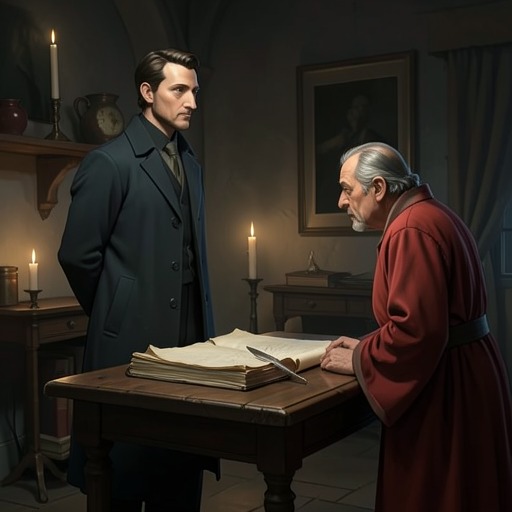
Cromwell hears the account from Cavendish, who comes to Austin Friars in tears. He asks whether Wolsey spoke of him again and learns that Wolsey had called his name during the night. The news deepens Cromwell’s sense of loss: he had arrived too late to see his former master, and the death he hears described ends the possibility of their reunion.
Cromwell tells Cavendish to reveal nothing about Wolsey’s last days when questioned. Cavendish says that he has already spoken with the king and Norfolk, and mentions that Norfolk has paid his overdue wages. Their exchange brings the practical aftermath of Wolsey’s fall into the same frame as private grief: servants must recover their belongings and settle accounts, while the cardinal’s former household disperses.
Wolsey’s death also leaves an absence at the centre of royal counsel. Henry VIII says he would not have wanted Wolsey to die, but Cromwell doubts that the king could raise the money to bring him back even if such a miracle were possible. At Leicester Abbey, the cardinal’s body is laid in a crypt; in the political world beyond it, Cromwell is left to reckon with the king’s dependence, the risks of counsel, and the work of carrying on without his former master.